
Dr. Diesel Technologies — ECU Service and Repair
DR. DIESEL TECHNOLOGIES + COJALI USA — Component-Level ECU Repair · Remanufacturing · Bench Simulation · Functional Verification · Failure Analysis · Lifecycle Sustainment Support
Diagnostic evaluation, component-level remanufacture, and bench-verified return of electronic control units (ECUs) for U.S. military fleets.
All work performed within the continental United States
01 / The Partnership
Your ECU Remanufacturing Service Provider
Replacing a failed electronic control unit is not always the fastest or most cost-effective route to returning a vehicle to mission-capable status. Increasingly, it is not even an available one. Dr. Diesel Technologies, in partnership with Cojali USA, returns the failed unit to service instead.
ECU Remanufacturing and Sustainment Capability
Restoring electronic control units. Returning assets to mission.
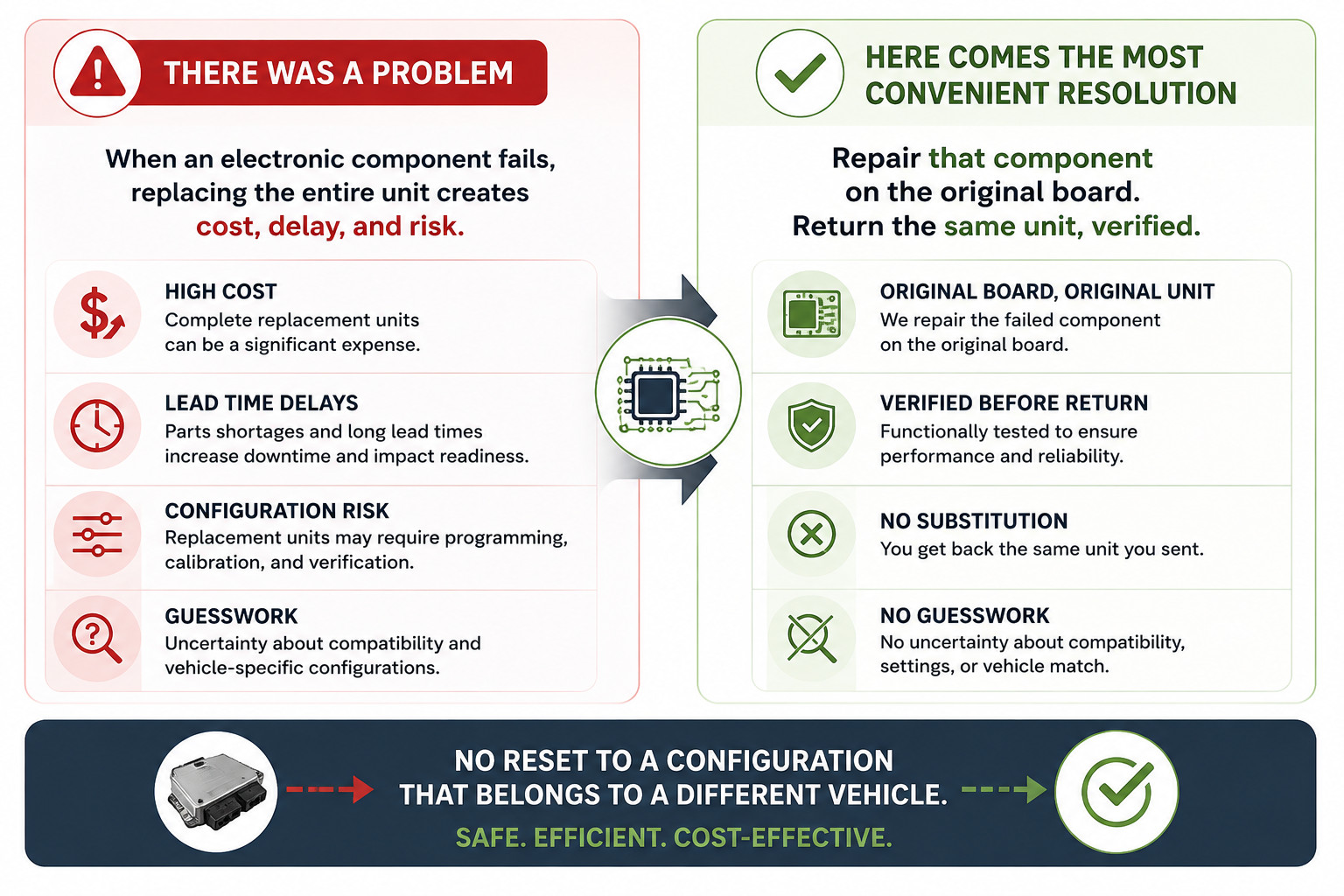
Electronic control unit failures can deadline otherwise serviceable equipment. Replacement is not always the fastest or most cost-effective path to restoring operational availability — and for aging or supply-constrained platforms, replacement units may carry extended lead times, limited availability, or be obsolete outright.
Dr. Diesel Technologies, in partnership with Cojali USA, provides a repair and remanufacturing capability designed to restore failed electronic control units and return the original unit to service.
For U.S. military Motor Transport and Heavy Equipment fleets, this capability provides an additional sustainment pathway intended to reduce dependence on replacement-unit availability, shorten maintenance delays, and support equipment readiness throughout the platform lifecycle.
This approach preserves the original unit rather than automatically introducing a replacement or exchange ECU into the vehicle. For the warfighter and the sustainment enterprise, the intended outcome is straightforward:
- Reduce ECU-maintenance-related deadlined vehicles
- Reduce replacement dependency
- Mitigate obsolescence
- Restore operational readiness
02 / The Readiness Case
Why Remanufacture Before Replace?
An additional sustainment path to operational availability.
Modern tactical and support vehicles depend on increasingly complex electronic control systems. When a critical ECU fails, an otherwise serviceable vehicle can become non-mission capable while maintenance personnel wait for a replacement assembly.
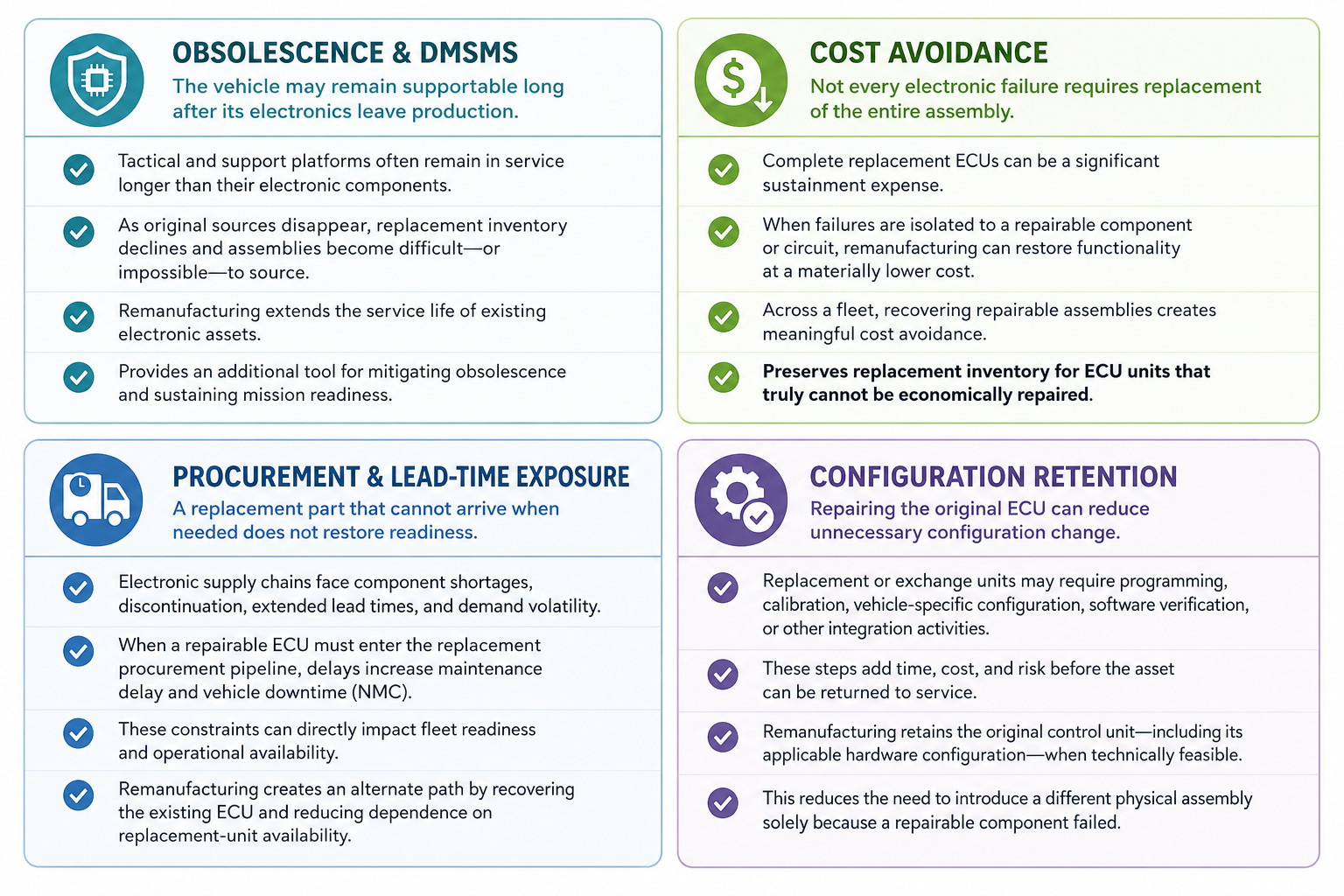
For many fielded platforms, the challenge extends beyond the failed ECU itself. Obsolescence, DMSMS, extended procurement lead times, supply-chain constraints, and rising replacement costs can turn a single electronic failure into a prolonged readiness issue.
Component-level remanufacturing provides an alternative sustainment pathway: recover the existing asset when technically and economically viable, rather than defaulting immediately to replacement.
Supply-Chain Resilience
Repair capability creates another source of readiness. A sustainment strategy dependent exclusively on new or replacement assemblies remains exposed to OEM production decisions, supplier capacity, inventory availability, and procurement lead times. Establishing an ECU remanufacturing pathway provides an additional source of support for selected electronic assemblies and can strengthen fleet resilience when conventional replacement channels are constrained.
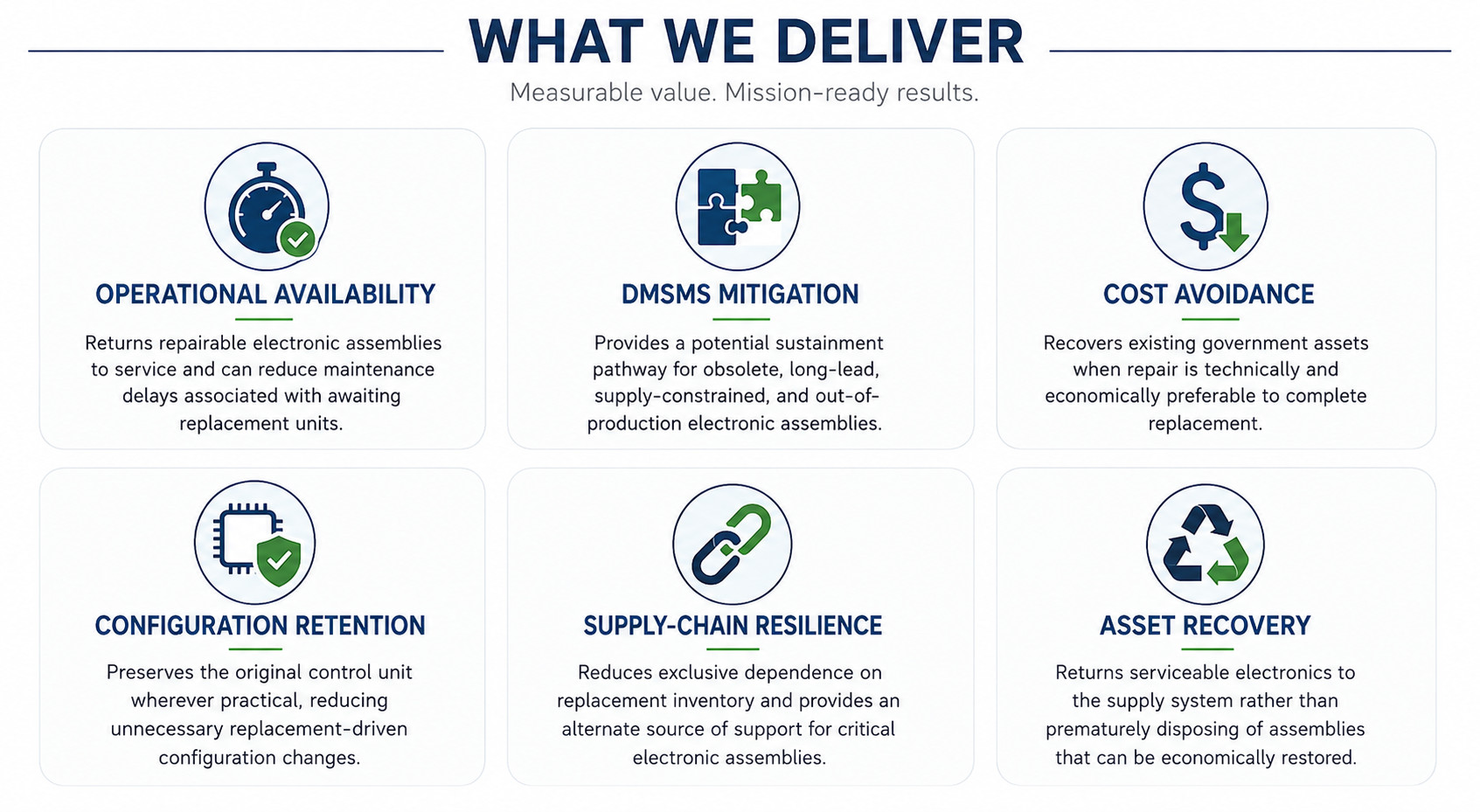
Repair when repairable. Replace when necessary.
The objective is not to eliminate replacement. It is to avoid unnecessary replacement when a controlled, verified remanufacturing process can return the existing asset to operational readiness faster and more economically.
03 / The Process
Remanufacturing Is a Controlled Process — Not an Ad-Hoc Bench Repair
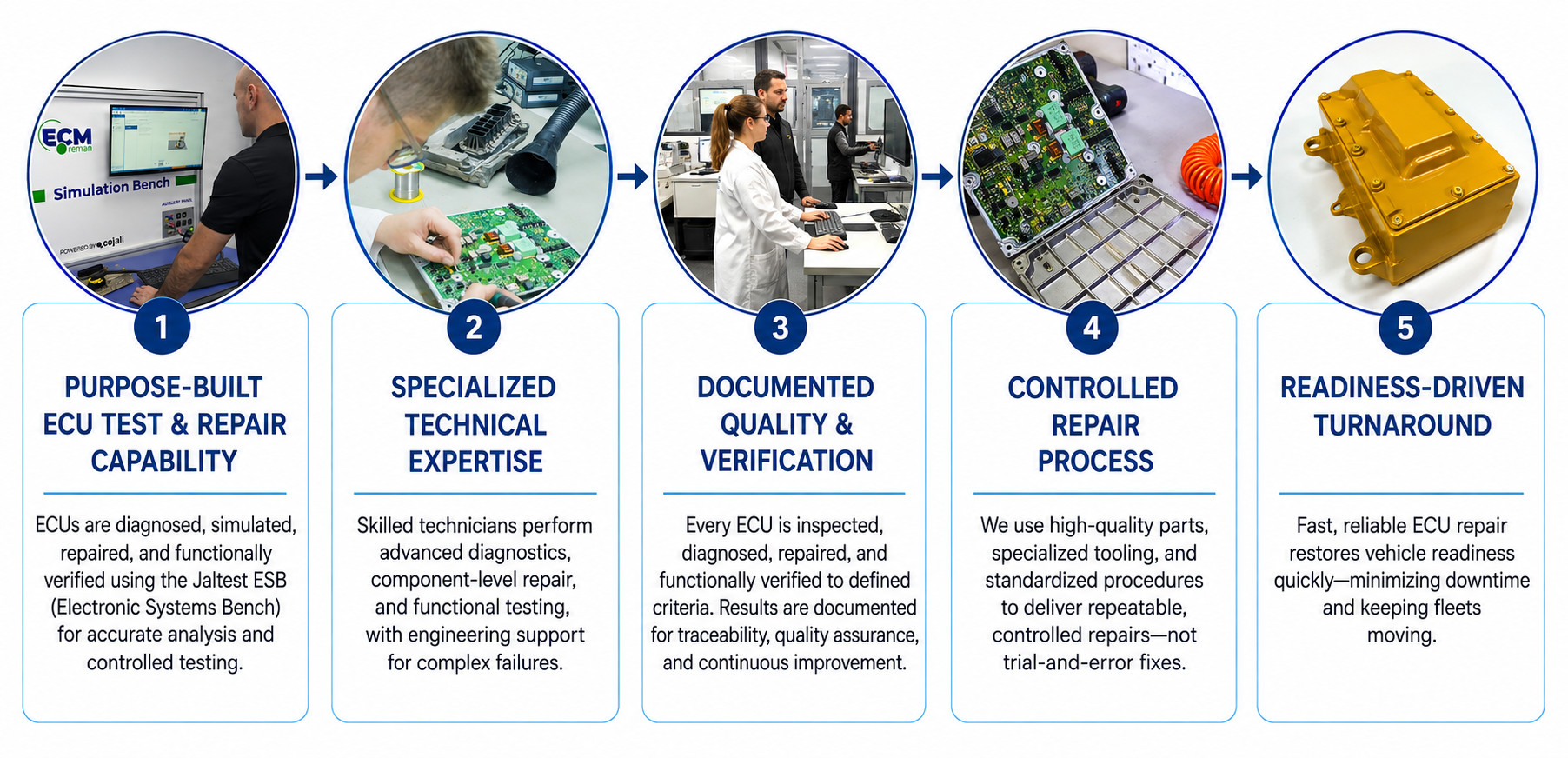
Each ECU progresses through a standardized, documented process encompassing inspection, fault isolation, component-level repair or replacement, and functional verification. Identified failed or degraded components are addressed using controlled materials and defined procedures. Before release, the remanufactured unit undergoes functional testing against established acceptance criteria to verify readiness for return to service.
The result is a documented, repeatable, and traceable sustainment process designed to recover the existing asset and return it to operational use with confidence.
Precision Diagnosis. Targeted Repair.
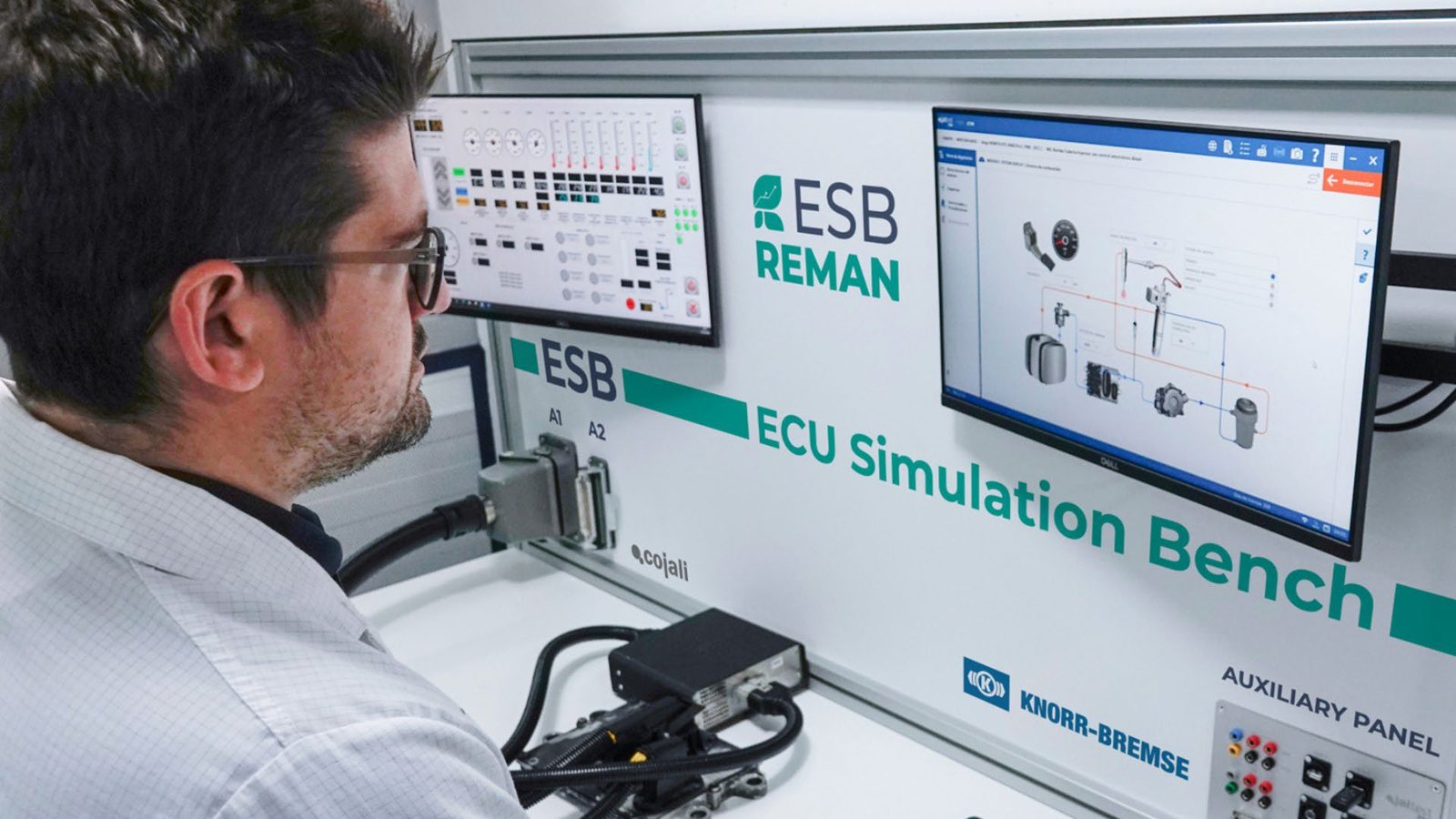
Successful ECU remanufacturing begins with accurate fault isolation. Using the Jaltest ESB — and Jaltest as integrated in the DATS-ECHO — technicians evaluate ECU behavior under controlled conditions to isolate the affected circuit or component before corrective action is taken.
Diagnose first. Repair precisely. Verify the result.
This disciplined approach reduces unnecessary component replacement and provides greater confidence that the underlying failure — not simply the symptom — has been addressed.
Past Performance — ECU Service
- USMC MDMC
- NAVFAC EXWC
How to Initiate a Repair
- Submit the request form below. You will receive a request number immediately.
- We review and confirm coverage. A representative from Dr Diesel Technologies will review the request and confirm coverage for the ECU information that was submitted.
- You receive shipping instructions and a quote for the ECU service requested.
- Ship the unit with the request number marked on the container and on the paperwork inside.
- Evaluation and remanufacture. The ECU unit is evaluated and remanufactured on dedicated Cojali test benches, then verified with an end-of-line functional test before return shipment.
Turnaround and warranty terms are confirmed per request, at the coverage confirmation step.
Eligibility. This intake is restricted to U.S. military and government requesters. A valid .mil or .gov email address is required.
Do not submit CUI. This form is not authorized for controlled unclassified information, classified information, or export-controlled technical data. Send only the equipment and ECU data requested. Anything further is handled through an authorized channel.
Questions before you submit: 1 888 698 3387 or customersupport@drdieseltech.com.
Dr Diesel Technologies · In partnership with Cojali USA
ECU Service & Repair Request
Diagnostic evaluation, remanufacture, and bench-verified return of electronic control units for U.S. military and government fleets. Engine, transmission, brake, suspension, aftertreatment, central computer, and instrument cluster controllers.
.mil or .gov email address is required.